
Loading…
ngnsimulation is now in active pilots with Alberta nursing & HCA programs.Request a pilot
Allied health platform
Allied Health Sciences is an AI training and assessment platform covering 57 allied health professions across 64 jurisdictions in Canada and the United States. In each jurisdiction, a profession appears under its correct local title, with the relevant regulator, privacy legislation, measurement units, and scope of practice. One platform can therefore support any program, whatever roles or rules it requires.
Coverage explorer
Select a profession and a jurisdiction to view the local title, regulator, governing legislation, units, examination, and scope-of-practice status.
Resolved title
Health Care Aide · localized for Ontario
What distinguishes it
Generating a clinical scenario is comparatively straightforward. Resolving it correctly for a specific profession, in a specific jurisdiction, under the applicable regulator and legislation is the more demanding task, and it is the problem this platform addresses.
Each profession resolves to the regulator or college responsible in its jurisdiction, including the CRNA, CNO, OIIQ, and the state Boards of Nursing.
Canadian health-information acts and PIPEDA, together with HIPAA in the United States, are applied within the AI prompts and grading.
Local titles, metric or imperial units, and the relevant licensure examinations are provided for all 64 jurisdictions.
The platform operates in English and Québec French and includes an ESL mode, reflecting the composition of the allied health workforce.
Inside the platform
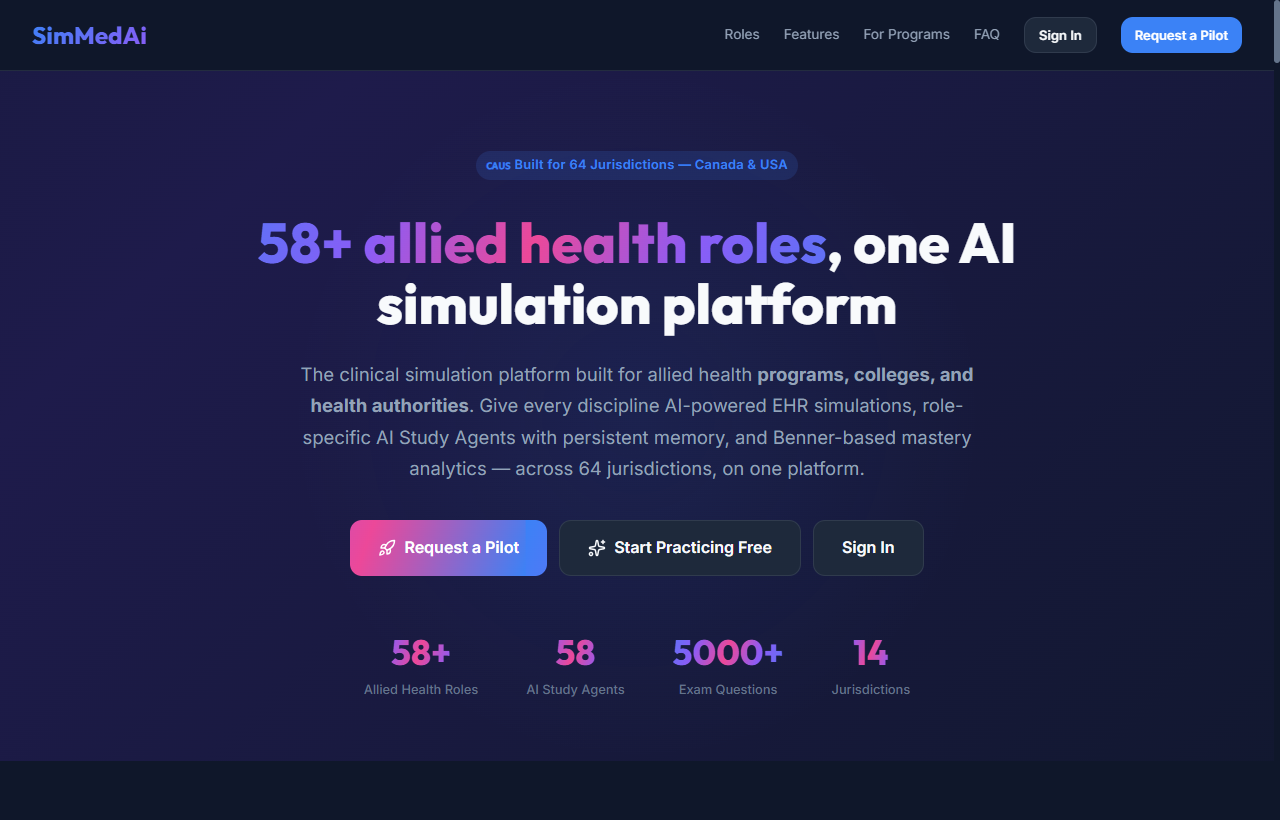
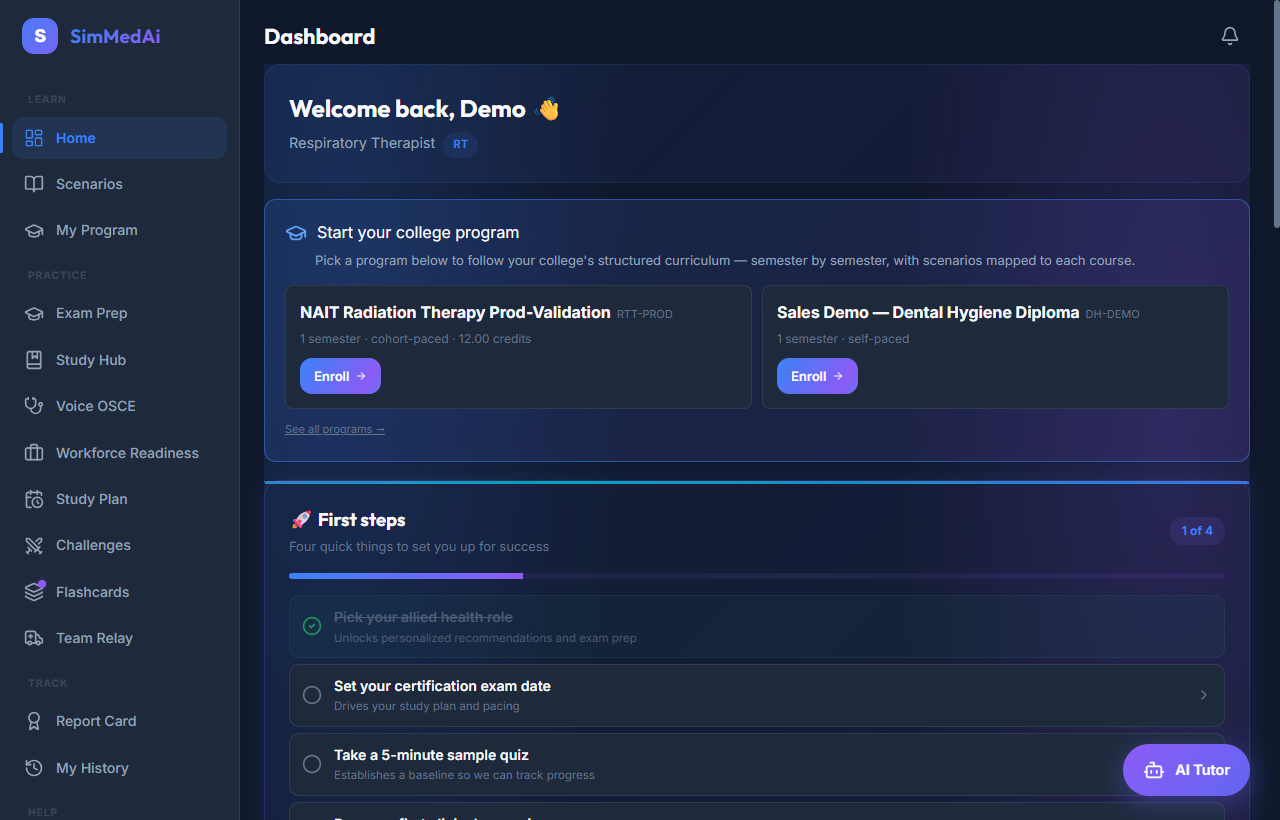
Allied Health Sciences runs on the SimMedAi platform, which provides AI-generated EHR simulations, a study agent for each profession, voice-based OSCE stations, workforce-readiness drills, and analytics for instructors.
For instructors and programs
Instructors can author scenarios, manage cohorts within a full learning-management system, and review each learner's standing. Institutional data is isolated by tenant.
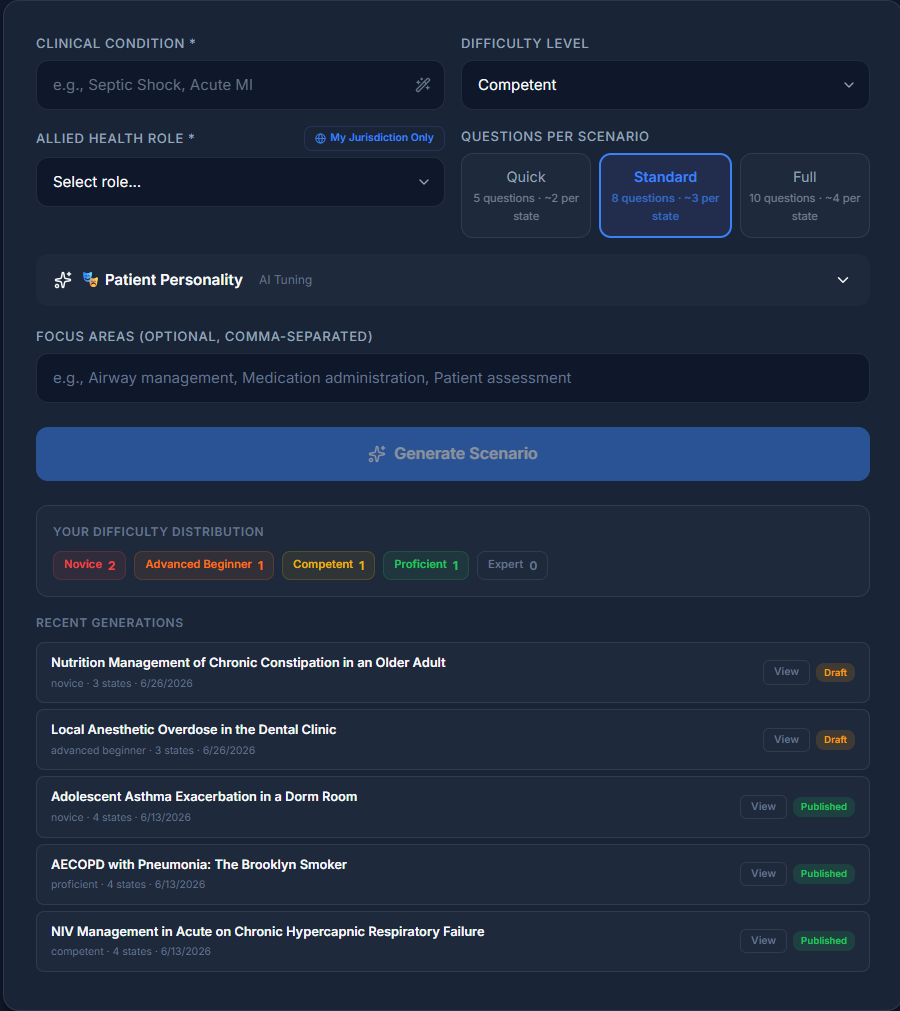
Generate an evidence-based scenario for a chosen profession and jurisdiction, setting the difficulty, the number of questions, and the patient disposition.
Review predicted pass rates, weak-topic indicators, and at-risk learners across a cohort, rather than raw scores alone.
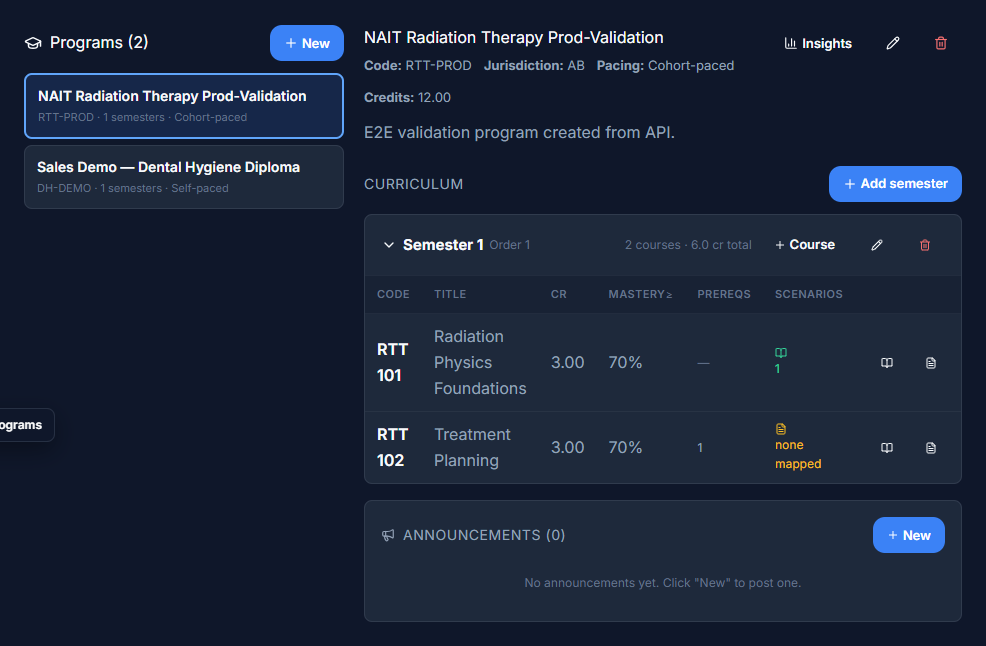
Build programs, terms, and courses with mastery thresholds, prerequisites, and credentials issued on completion.
Review and calibrate voice OSCE encounters and workforce-readiness drills, with documented instructor scoring.
Manage a full roster with search, sorting, score overrides, and per-learner mastery trajectories based on Benner's framework.
Each institution operates within its own isolated schema, so cohorts and learner data remain separate.
57 professions
The catalogue is organized into 13 families. Each profession is reproduced for every jurisdiction, so it carries the appropriate local title and requirements.
64 jurisdictions
All 13 Canadian provinces and territories, together with the United States nationally and all 50 states. Each jurisdiction has its own regulator, privacy regime, and units.
FAQ
Allied Health Sciences is an AI training and assessment platform. It covers 57 allied health professions and localizes each one across 64 jurisdictions in Canada and the United States, which produces approximately 3,600+ profession-by-jurisdiction records. For each record, the profession is presented under its correct local title, with the applicable regulator, governing privacy legislation (PIPEDA and provincial health-information acts in Canada, HIPAA in the United States), measurement units, and, where documented, its legal scope of practice.
The platform covers 64 jurisdictions: all 13 Canadian provinces and territories, together with the United States nationally and all 50 states. A jurisdiction-agnostic clinical core is available for content that does not require a regional overlay.
Each profession resolves to its local title automatically. A Health Care Aide in Alberta is titled Personal Support Worker in Ontario, and Certified Nursing Assistant (or, in some states, State Tested Nurse Aide) across much of the United States. Every record also carries the local regulator, privacy regime, and units.
A documented scope of practice defines the permitted, restricted, and controlled acts for a profession in a given jurisdiction, with citations. 11 profession families currently have a documented scope, including Registered Nurse, Licensed Practical Nurse, paramedicine, pharmacy technician, and dental roles. The remaining professions operate with identity-correct clinical context until their scope is documented. Where a scope exists, out-of-scope actions are identified during simulation, OSCE, and grading.
The platform is intended for colleges and training providers, health authorities and employers, and individual learners across the allied health workforce. Because coverage extends to every profession and jurisdiction in the catalogue, a single deployment can support programs with differing professional and regulatory requirements.
For a specific credential, see the focused examination-preparation products built on the same engine.
Allied Health Sciences covers the professions and jurisdictions your programs require. We can map it to your curriculum.