
Loading…
ngnsimulation is now in active pilots with Alberta nursing & HCA programs.Request a pilot
Competency-based education asks what a nursing graduate can do, not what the curriculum covered. Curriculum mapping is where most programs discover the gap.
By The ngnsimulation team
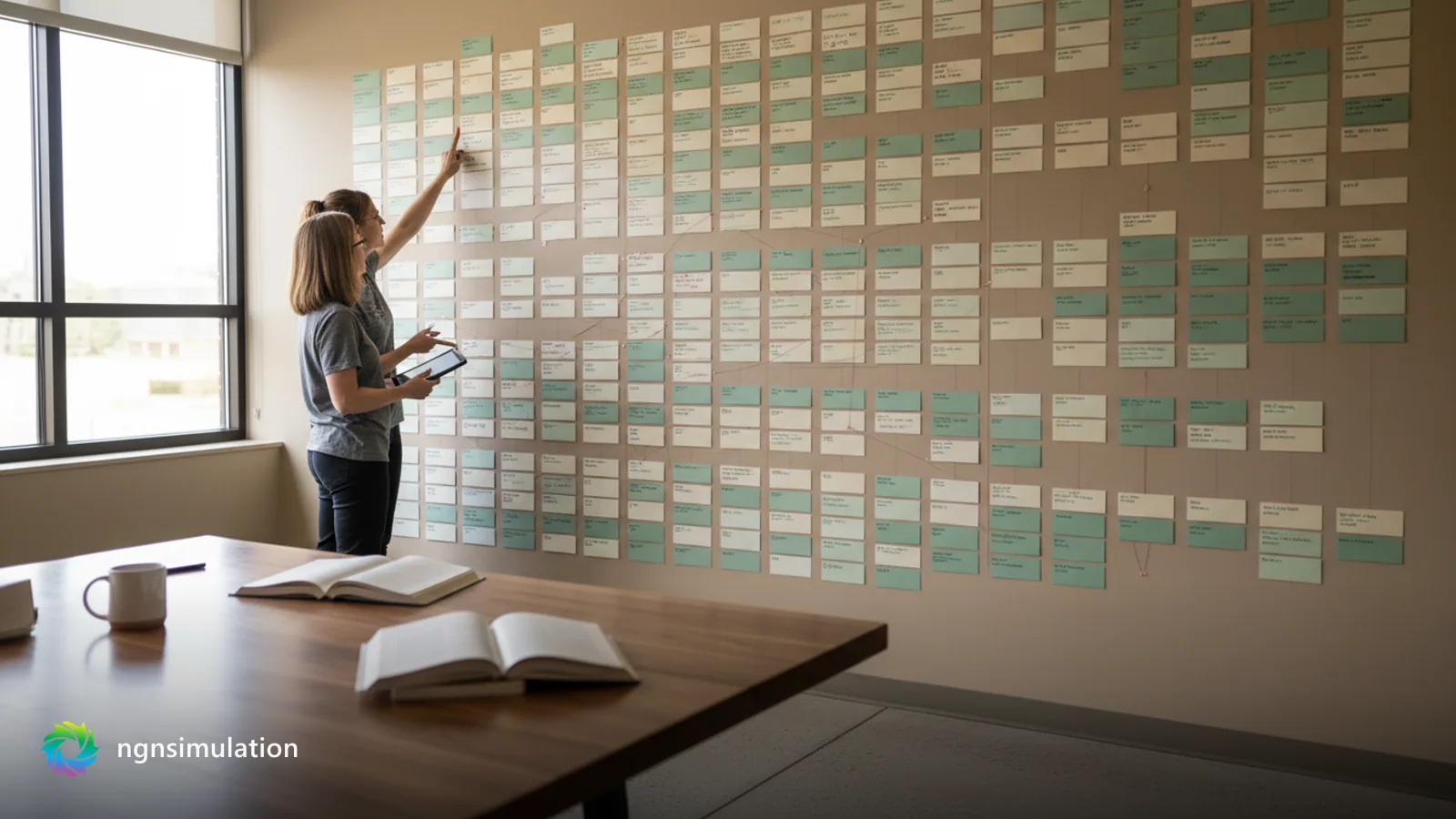
Competency-based education in nursing replaces a coverage question with a performance question. The older model asked whether a curriculum addressed a topic and where. The competency model asks whether a specific student demonstrated a specific ability at a specific point, and what evidence the program holds that it happened.
This sounds like a philosophical shift and is mostly an evidentiary one. Programs were already trying to produce competent graduates. What changed is the standard of proof, and proof is a documentation discipline that most curricula were not built to supply.
Curriculum mapping is usually the first exercise a program undertakes, and it produces a reliable and uncomfortable result. Mapping content to competencies is straightforward; nearly every competency turns out to be addressed somewhere, often in several places. Mapping evidence to competencies is where the exercise stalls.
The reason is the course grade. A grade aggregates examination performance, written work, participation, and clinical evaluation into a single figure. It cannot afterwards be decomposed to show that a particular competency was demonstrated, because the information was destroyed at the point of aggregation. A program with a decade of transcripts has a decade of grades and very little competency evidence.
| Artefact | Shows content was taught | Shows competency was demonstrated |
|---|---|---|
| Syllabus and course map | Yes | No |
| Course grade | Indirectly | No |
| Multiple-choice examination | Yes, for knowledge | Only for knowledge competencies |
| Clinical evaluation narrative | Partly | Weakly, and inconsistently between evaluators |
| Skills checkoff against a rubric | Yes | Yes, for that skill |
| OSCE or structured simulation with a rubric | Yes | Yes, including judgement |
The bottom two rows are what programs need more of, and most already have some. The practical first step is inventory rather than design: find the existing artefacts that already constitute evidence before building anything new.
The genuinely hard part is not identifying evidence but making it consistent. If two clinical instructors watch the same student perform the same assessment and reach different conclusions, the program has recorded two opinions. Accreditors ask how consistency is established, and it is the question programs answer least convincingly.
Three mechanisms address it, in ascending order of effort. A shared rubric with behavioural descriptors rather than adjectives. A calibration exercise where evaluators assess the same recorded performance and reconcile differences. And standardised delivery, where the scenario itself is identical for every student so the only variable is the student.
The third is where structured simulation earns its place in a competency framework, and the claim is worth keeping precise. A scenario delivered identically, assessed against a fixed rubric, at a defined point in the program, produces exactly the artefact the standards describe. It does not solve evaluator disagreement on its own, but it removes the scenario as a source of variance, which is the largest one.
The revised AACN Essentials organise competencies into domains with expected behaviours at defined levels, and they are the framework most North American programs are mapping against. Their practical effect has been to move curriculum mapping, assessment design, and documentation from departmental housekeeping to institutional strategy, because accreditation now turns on them.
Domain 8, covering informatics and healthcare technologies, is a likely gap, since the teaching is recent and, where it exists, is commonly assessed by written reflection rather than observed performance. That specific gap is examined at ai literacy vs ai clinical competency nursing, and the accreditation timeline is at nursing accreditation standards transition 2026.
The most common failure is treating this as a curriculum redesign. Programs convene committees, restructure courses, and rewrite objectives, consuming faculty time across terms, and arrive at an equally unprovable curriculum. The education was rarely the deficiency. The deficiency is that competent practice was assessed informally by experienced people who knew a good student when they saw one, and that judgement, however sound, is not evidence.
Framed as making existing judgement explicit and consistent, the work is finite and largely administrative. Framed as rebuilding a curriculum, it expands without limit and produces resistance from faculty who correctly perceive that their teaching was not the problem.
The timeline is easy to underestimate, because the design work is visible and the operational work that follows is not. The sequence below is the shape of it; how long each phase takes depends on where a programme starts, and inventing a number here would be no help to anyone planning against it.
| Phase | Work | Depends on |
|---|---|---|
| Inventory | Locate existing competency evidence across the programme | How evidence is currently filed |
| Gap analysis | Map evidence, not content, and list competencies without it | Number of competencies without direct evidence |
| Instrument design | Build or redesign assessments for the gaps, with rubrics | Whether existing assessments can be adapted |
| Calibration | Train evaluators, reconcile differences on sample performances | Number of evaluators and how far apart they start |
| First full cycle | Run a cohort through and find what does not work | Programme length |
| Remediation of the process | Fix retrieval, storage, and the failure pathway | Ongoing |
The phase easiest to leave out of a plan is calibration, and it is the one that determines whether the evidence is defensible. It is also unpopular, because it requires experienced faculty to discover that they disagree with each other about performances they were each confident judging. That discovery is the point of the exercise, and programmes that skip it are producing inconsistent evidence without knowing it.
The first full cycle reliably surfaces problems that no amount of design anticipates: a rubric criterion nobody can observe in the time available, an assessment scheduled when students have not yet been taught the competency, a storage system that works until the record count grows. Planning for a corrective term after the first cycle, rather than treating the first cycle as the finished state, is the difference between a framework that survives and one that is quietly abandoned.
Try a real clinical-judgment question and see the reasoning coached step by step.