
Loading…
ngnsimulation is now in active pilots with Alberta nursing & HCA programs.Request a pilot
Simulation clinical hour replacement limits now exist in about 90 percent of US states, ranging from 25 to 100 percent of hours at ratios between 1:1 and 2:1.
By The ngnsimulation team
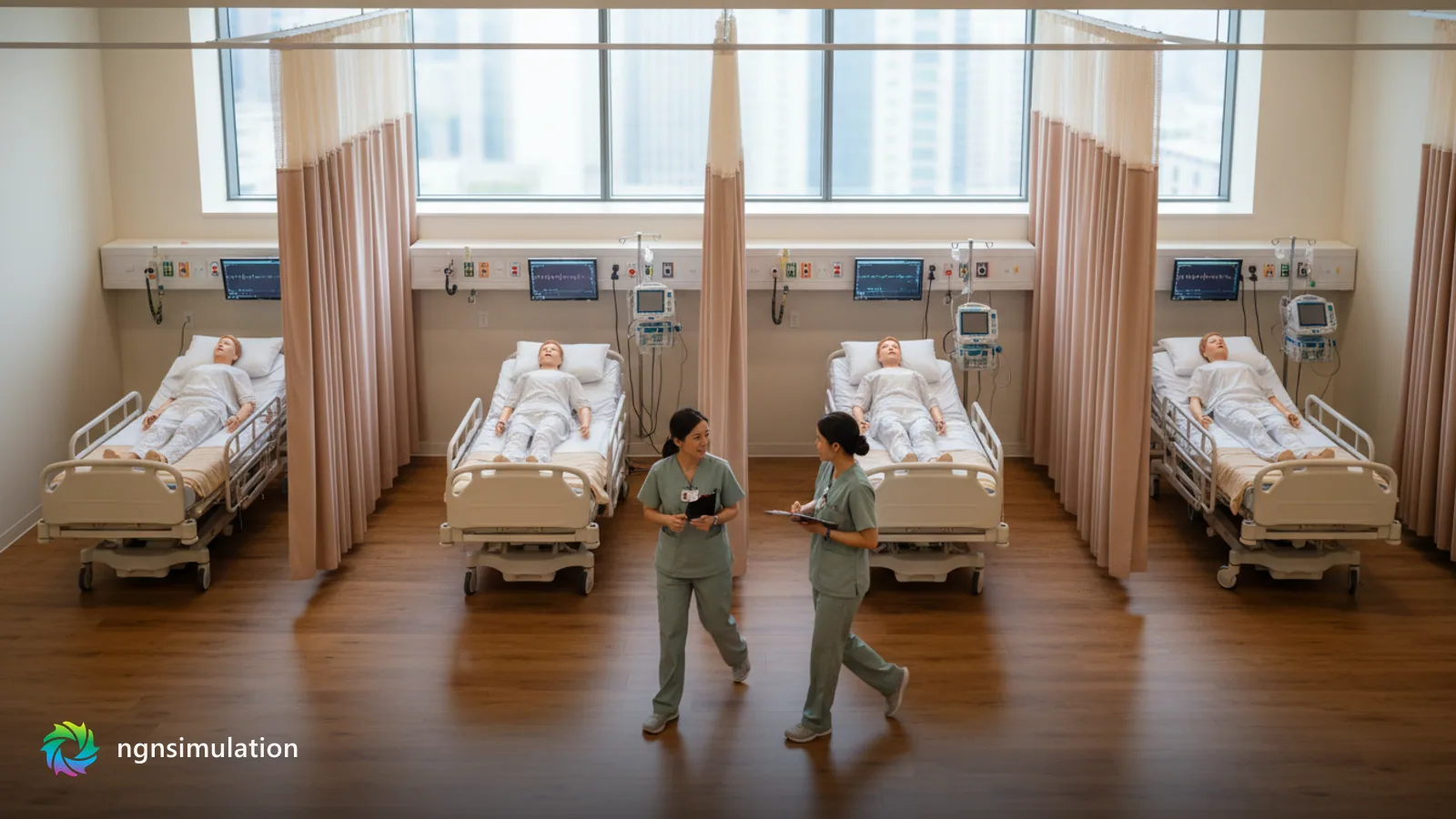
Simulation clinical hour replacement limits determine how much of a pre-licensure program's required supervised practice can be met in a simulation lab rather than at a clinical site. The answer is jurisdictional, it has changed substantially since 2022, and it is the single most consequential regulatory fact for any program trying to expand enrolment against a placement shortage.
This article is about the limits themselves. Whether simulation counts at all, and what makes it count, is covered separately at does simulation count toward clinical hours.
Boards of nursing express this differently, but nearly every rule reduces to three numbers. Reading a regulation without separating them is the most common source of misinterpretation.
| Variable | What it means | Typical range |
|---|---|---|
| Substitution cap | The maximum share of total clinical hours that may be met through simulation | 25 to 100 percent |
| Replacement ratio | How many simulation hours retire one clinical hour | 1:1 to 2:1 |
| Quality conditions | Faculty preparation, standardised debriefing, scenario design, evaluation | Frequently references INACSL or NCSBN guidance |
The ratio is the variable most often overlooked. A state permitting 50 percent substitution at a 2:1 ratio is not offering the same thing as a state permitting 50 percent at 1:1. In the first case a program must deliver two hours of simulation to retire one hour of placement, which changes the lab scheduling and staffing arithmetic considerably.
A review of simulation regulation across 2022 to 2024 found that approximately 90 percent of US states now have some regulatory provision addressing simulation in pre-licensure nursing education. That is a substantial change from a decade earlier, when the majority of boards were silent and programs operated on inference.
Silence is not permission, and it is not prohibition either. In the small number of jurisdictions with no explicit rule, programs generally proceed on accreditor guidance and board correspondence rather than statute. Any program in that position should obtain the board's view in writing before building an enrolment plan on it.
The most cited number in this area is 50 percent, and it has a specific origin. The National Council of State Boards of Nursing conducted a large multi-site randomised study comparing pre-licensure cohorts with varying proportions of simulation substituted for traditional clinical time. It found no meaningful difference in clinical competency, nursing knowledge, or NCLEX pass rates for cohorts substituting up to half their clinical hours with high-quality simulation.
Two qualifications travel with that finding and are frequently dropped when it is quoted. The study's conditions included prepared faculty, scenarios built to recognised standards, and structured debriefing by trained facilitators. The result supports substitution under those conditions; it does not support substitution as such. Boards that adopted the 50 percent figure generally adopted the conditions with it, which is why the quality language in a regulation is not decorative.
Twelve states specifically mention virtual simulation in their regulations. The rest were written with the physical lab in mind, which leaves a genuine ambiguity for programs using screen-based or AI-driven scenarios: does a virtual encounter count toward the same cap, a different cap, or not at all?
The distinction that most boards are converging on is not the medium but the structure. A scenario with defined objectives, a facilitator, and a debrief is treated as simulation. Self-directed practice on a screen without those elements is treated as coursework. Programs are on considerably safer ground when a virtual modality is delivered inside the same instructional structure as lab-based simulation rather than assigned as independent study. The comparison between the two modalities is set out at virtual simulation vs manikin simulation.
Canadian programs face a differently shaped version of the same question, since regulation sits with provincial bodies rather than state boards and the terminology differs. The jurisdictional variation across roles and provinces is mapped at Allied Health Sciences.
A program already at its substitution cap gains no additional placement relief from more simulation. It may still gain educationally, and it may still gain through displacement, where rehearsal moves off the supervised schedule so preceptor time concentrates on judgement. But the direct conversion of simulation hours into placement capacity is finished at the cap.
This is the calculation worth doing before a purchase rather than after. Where a program sits relative to its cap, and what its ratio is, determines whether simulation is a capacity instrument or an educational one for that institution. Both are legitimate. They are not the same business case, and the ROI estimator separates them.
Every substitution rule is conditioned on simulation quality, and the conditions are not decorative. They are the reason the NCSBN result held, and a board that adopted the percentage without the conditions is rare. Programs that treat the quality language as boilerplate are the ones that discover during a site visit that their substituted hours are being questioned.
The conditions recur across jurisdictions with enough consistency to plan against. Faculty facilitating simulation are expected to have preparation in simulation pedagogy specifically, not merely clinical expertise. Scenarios are expected to have written objectives tied to programme outcomes. Debriefing is expected to be structured and led by a prepared facilitator rather than an informal conversation at the end of a session. Equipment and environment are expected to support the fidelity the objectives require, which is a lower bar than it sounds and is usually met.
Debriefing is the condition most often underestimated. It is a required element of high-quality simulation under the standards boards reference, and it is the element most likely to be compressed when a lab is running behind schedule. A programme that substitutes hours while cutting debriefing to save time has kept the form and discarded the mechanism, and the substituted hours are correspondingly weaker than the regulation assumes.
The practical test is whether a programme could demonstrate each condition to an evaluator with documents it already holds: facilitator preparation records, scenario objectives, a debriefing protocol, and evidence that the protocol is followed. Programmes that can produce these are on solid ground at any cap. Programmes that cannot are exposed regardless of how conservative their substitution percentage is.
Try a real clinical-judgment question and see the reasoning coached step by step.