
Loading…
ngnsimulation is now in active pilots with Alberta nursing & HCA programs.Request a pilot
Virtual simulation and manikin simulation solve different constraints. One scales repetition cheaply, the other teaches the body. Start with which one binds.
By The ngnsimulation team
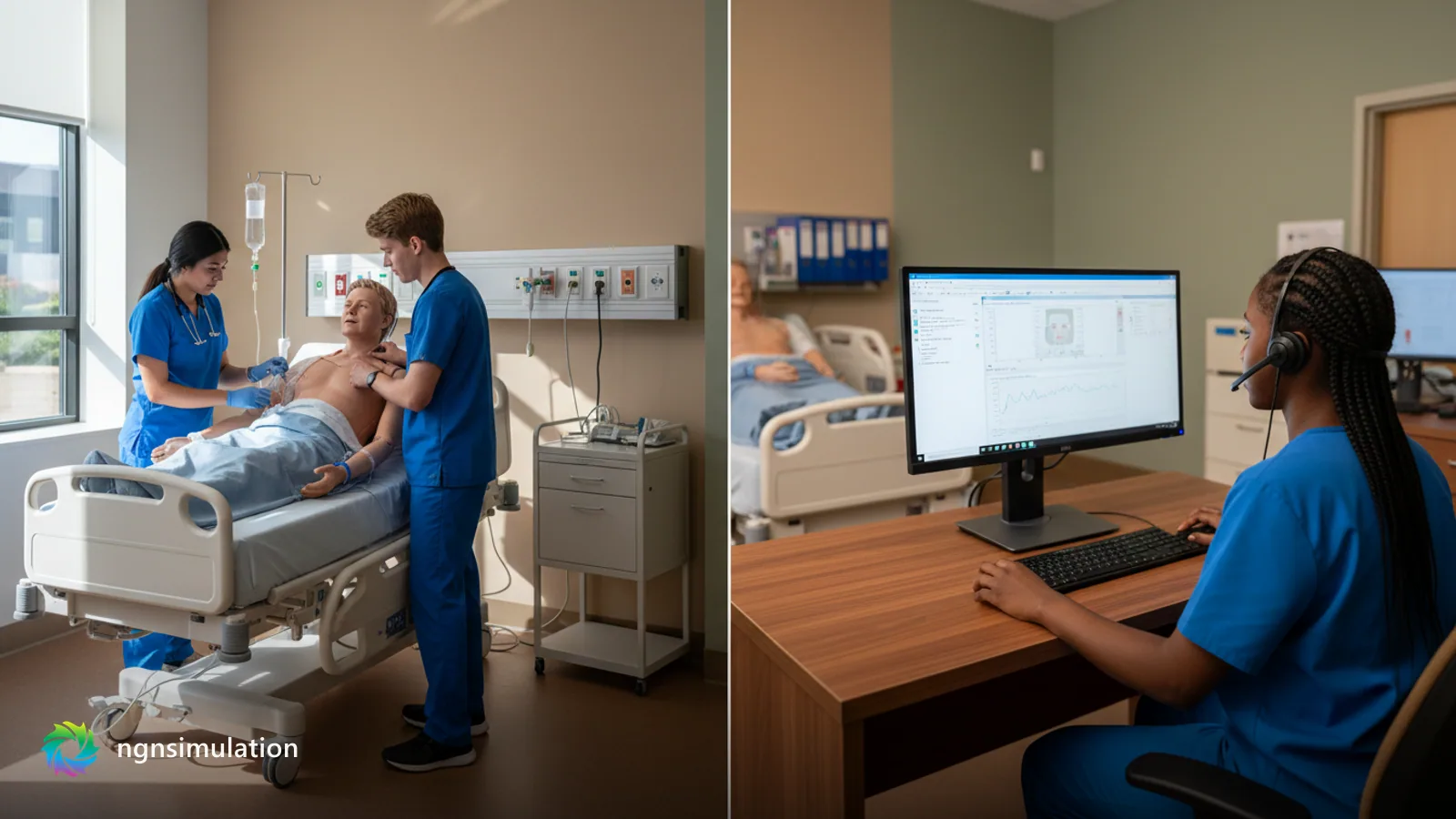
Virtual simulation and manikin simulation are routinely compared as if a program must choose one. That framing produces bad decisions, because they relieve different constraints. The useful question is not which is better but which constraint is currently binding, and the answer varies by program and by term.
| Dimension | Manikin simulation | Virtual simulation |
|---|---|---|
| Core strength | Physical skill, team coordination, embodied practice | Cognitive repetition, decision-making, volume |
| Marginal cost of one more run | High: room, equipment, facilitator | Low: effectively a licence |
| Capacity ceiling | Bays, equipment, facilitator hours | Concurrent licences |
| Scheduling | Booked, cohort-synchronised | Asynchronous, any hour |
| Teaches hands | Yes | No |
| Teaches interprofessional dynamics | Strongly, in a shared room | Partially, and only if designed for it |
| Consistency across students | Varies with facilitator | Identical by construction |
| Capital requirement | Substantial and recurring | Minimal |
Two rows deserve emphasis. The marginal cost row is the reason virtual simulation exists: once a scenario is built, the tenth student costs almost nothing, while the tenth manikin run costs a bay and a facilitator hour. The consistency row is the reason it matters for assessment: a virtual scenario is delivered identically to every student, which is difficult to guarantee with human facilitators across sections.
It does not teach the body. Sterile technique, positioning, transfers, catheterisation, resistance felt through a syringe, the physical coordination of a resuscitation team in a crowded room: these are learned by doing them with hands, and no screen substitutes. A program that reduced manikin hours to fund virtual licences on the theory that they are interchangeable would produce graduates who reason well and cannot perform.
It is also weaker on the unscripted interpersonal dimension of a team in a room together, where the learning includes noticing what a colleague missed and speaking up about it. Virtual scenarios can approach this when deliberately designed for it, but the default form is a single student and a system.
It cannot scale to the volume that competence in judgement requires. Every run of a scenario consumes a bay, the equipment and a facilitator hour, so how often a student can repeat a given high-acuity scenario is set by the timetable and the staffing budget rather than by how much repetition the learning would take. Those two numbers are set by different things, and nothing guarantees they meet. This is the gap virtual simulation exists to fill, and it is a real one.
Manikin simulation is also expensive to keep current. Equipment ages, scenarios calcify, and facilitator preparation is a recurring cost that competes with teaching load.
Twelve US states mention virtual simulation explicitly in regulation. The remainder were drafted with the physical lab in view, which leaves programs to interpret. The pattern emerging in board guidance is that credit follows instructional structure rather than medium: a scenario with stated objectives, a facilitator, and a structured debrief is treated as simulation; unstructured independent practice on a screen is treated as coursework, however sophisticated the software.
The operational consequence is straightforward. A program intending virtual scenarios to count toward clinical hour substitution should deliver them inside the same instructional wrapper as its lab simulation, with a facilitator and a debrief, rather than assigning them as homework. The substitution caps and ratios that then apply are set out at simulation clinical hour replacement limits by state.
The arrangement that follows from treating the modalities as complements is sequential rather than parallel. Cognitive rehearsal happens virtually and asynchronously before the lab. Students arrive at the manikin already fluent in the reasoning, so the scarce facilitator hour is spent on the physical performance and the team behaviour that only the room can teach, rather than on explaining the scenario.
This is the same displacement argument that governs clinical placement, applied one layer earlier: the constrained resource is protected by moving preparation off it. The placement-level version is at why nursing programs turn away qualified applicants.
A purchasing decision made on sticker price favours whichever option is being renewed rather than whichever is efficient. The comparison that matters is cost per student contact hour, and it produces a different ranking.
| Cost element | Manikin lab | Virtual platform |
|---|---|---|
| Initial outlay | Substantial capital | Licence, typically annual |
| Cost of the first student hour | Very high | High |
| Cost of the hundredth student hour | Nearly unchanged per hour | Approaching zero |
| Facilitator time per student hour | Required throughout | Required for debrief only |
| Refresh cycle | Equipment ageing, typically years | Software, continuous |
| Cost when enrolment grows 20 percent | Rises with bays and facilitator hours | Often flat within licence tiers |
The row that should decide the case is the last. A manikin lab at capacity cannot absorb a larger cohort without capital and staffing that arrive on a multi-year timeline. A virtual platform may absorb the same growth within an existing licence tier, which is worth checking against the licence terms. For a division under pressure to expand enrolment, that difference in marginal behaviour matters more than the difference in headline price.
The corresponding caution is that a virtual platform priced per student becomes expensive at scale in exactly the situation where it is most useful, and licence structures should be examined for that. A per-seat price that is attractive at 40 students and punitive at 400 is a capacity instrument that stops working when capacity grows.
None of this argues for substituting one modality for the other. It argues for putting the growth in the modality whose costs grow slowly, and protecting the modality whose costs grow quickly for the work only it can do.
Try a real clinical-judgment question and see the reasoning coached step by step.