
Loading…
ngnsimulation is now in active pilots with Alberta nursing & HCA programs.Request a pilot
Canada's EMR, PCP and ACP levels do not map onto the US EMT and Paramedic, and the exams behind them differ in who runs them, how often, and what they test.
By The ngnsimulation team
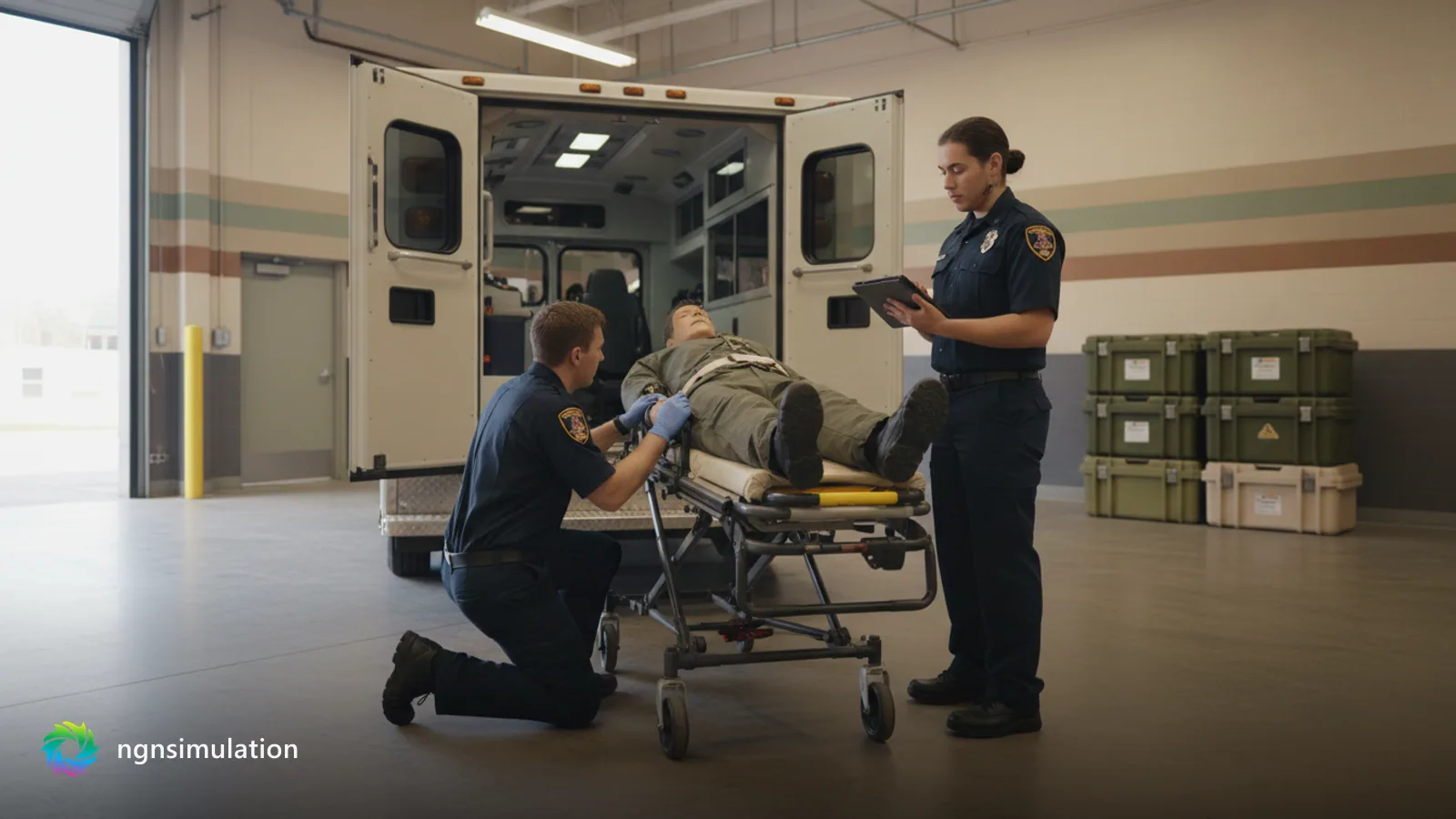
Paramedic vs EMT is a comparison that goes wrong at the first step, because the titles do not line up across the border. A Canadian paramedic and an American paramedic are not the same level of practitioner, and a Canadian PCP is not an EMT with a different name. This guide sets out the levels, who examines them, how the examinations are built, and what the American data say about how many students get through.
| Canada | Nearest US level | Note |
|---|---|---|
| Emergency Medical Responder (EMR) | Emergency Medical Responder (EMR) | The one title that matches |
| Primary Care Paramedic (PCP) | EMT, with the AEMT between | The PCP is the entry paramedic level in Canada; the US reserves 'paramedic' for the advanced level |
| Advanced Care Paramedic (ACP) | Paramedic | The closest pairing in scope |
| Critical Care Paramedic (CCP) | No NREMT level at this tier | The National Registry certifies four levels: EMR, EMT, AEMT and Paramedic |
The practical consequence is that a job title is not evidence of level. A Canadian PCP describing themselves as a paramedic in the United States will be read as an EMT-level practitioner, and an American Paramedic moving north is closer to an ACP. Every equivalency decision runs through the receiving regulator, which works from competencies rather than titles.
In Canada there is no single national examination. The Canadian Organization of Paramedic Regulators runs entry-to-practice examinations for the EMR, PCP and ACP levels, and they are used in British Columbia, Alberta, Saskatchewan, Manitoba, Nova Scotia, Prince Edward Island, and Newfoundland and Labrador. Ontario is the largest exception: the Ministry of Health's Emergency Health Services administers the Advanced Emergency Medical Care Assistant examination for entry-level PCPs and a separate ACP examination. Provinces outside the COPR list make their own arrangements, and the receiving regulator is the only reliable source for them. The provincial picture, including Alberta's three practitioner levels, is set out at how to become a paramedic in alberta.
In the United States the National Registry of Emergency Medical Technicians runs national certification at the EMR, EMT, AEMT and Paramedic levels. National certification is not itself a licence to practise; each state licenses its own practitioners, and most reference the NREMT credential in doing so.
| COPR (PCP and ACP) | Ontario AEMCA and ACP | NREMT Paramedic | |
|---|---|---|---|
| Sittings | Five in 2026: February 11, May 6, July 8, September 9, November 12 | Three a year; in 2026 the AEMCA on February 11, June 10 and October 7, the ACP on February 4, June 24 and October 14 | By appointment at Pearson VUE test centres |
| Format | In the examination handbook | In the application guide | Computer-adaptive, 110 to 150 items, 20 of them unscored |
| Time | In the examination handbook | In the application guide | Three and a half hours |
| Pass standard | In the examination handbook | In the application guide | 950 on a 100 to 1500 scale |
| Fee | ACP: $650 plus tax per attempt | In the application guide | $175 |
| Retakes | In the examination handbook | In the application guide | 15-day wait; six attempts; remedial education after three failures |
| Practical examination | In the examination handbook | In the application guide | None since June 30, 2024; skills are verified by the program |
The NREMT figures are the most specific because the National Registry publishes a candidate handbook with the numbers in it, whereas COPR and Ontario publish dates and eligibility on their public pages and keep format, timing and pass standards in the handbook and application guide issued to registered candidates. The examination is adaptive, so the number and difficulty of items vary by candidate, and it consists primarily of multiple-choice items with multiple-response and technology-enhanced items alongside. The retake rule is worth reading twice: three failures trigger mandatory remedial education, and six is the limit.
The single examination introduced on July 1, 2024 replaced the separate cognitive and psychomotor tests. The published content distribution gives clinical judgment 34 to 38 percent of the examination, ahead of medical, obstetric and gynaecological care at 24 to 28 percent, with cardiology and resuscitation, airway and ventilation, EMS operations and trauma making up the rest. The psychomotor examination is gone from the certification pathway, and hands-on skill verification now sits with the training program, which must attest to it.
This is the same direction nursing took with the Next Generation NCLEX: the licensing examination measures the decision, and the program is accountable for the hands. For a paramedic program that means the examination its graduates sit is now more than a third clinical judgment, and clinical judgment is rehearsed through cases, not through skills stations.
The removal of the psychomotor examination shifts work rather than removing it. Before July 2024 a candidate could fail certification on a skills station regardless of what their program had signed off. Now the program's attestation is the skills gate. The examination that remains is adaptive and weighted toward judgment, so the preparation that used to go into rehearsing a station in front of an evaluator is better spent on cases that change as the candidate acts on them.
COPR has begun the transition from the National Occupational Competency Profile to the Canadian Paramedic Competence Framework. The final ACP examination sitting written to the NOCP is April 2027, and the first ACP examination written to the CPCF is scheduled for June 16, 2027. A student entering a multi-year ACP program now will graduate into the new framework, and the examination blueprint their program was built against may not be the one they sit.
The most useful figure in paramedic education comes from a 2023 study in JACEP Open, using National Registry data on students who enrolled in 640 accredited US paramedic programs in 2019. Of 17,457 students enrolled, 13,884 graduated, so 3,573 or 21 percent were lost to attrition during the program. Of the graduates, 12,002 passed the certifying examination within three attempts, so a further 1,882 or 11 percent were lost at the examination. The authors' summary is that nearly one in three students who enrol never reach the available workforce.
| Stage, US paramedic programs, 2019 cohort | Students | Share of enrolment |
|---|---|---|
| Enrolled | 17,457 | 100% |
| Graduated | 13,884 | 79% |
| Certified within three attempts | 12,002 | 69% |
| Lost to attrition | 3,573 | 21% |
| Lost at the examination | 1,882 | 11% |
No equivalent national figure is published for Canada, because there is no single Canadian examination to publish it from. The American number is nonetheless the right planning assumption for any program on either side of the border, for a simple reason: the students lost at the examination had already consumed a full program's worth of placement, preceptor and laboratory capacity. In a profession where capacity is the constraint, an eleven percent examination loss is eleven percent of the scarcest resource spent on graduates who cannot practise.
Decide where you intend to practise before you decide how to prepare, because the jurisdiction chooses the examination. Then prepare for the format as well as the content: an adaptive examination with a fifteen-day retake wait rewards a different kind of readiness from a scheduled sitting held five times a year. And if you intend to cross the border in either direction, start from the receiving regulator's equivalency process, which works from competencies, not from the word on your badge. The role across every jurisdiction is at primary care paramedic, and jurisdiction-specific practice is available at the demo.
Try a real clinical-judgment question and see the reasoning coached step by step.