
Loading…
ngnsimulation is now in active pilots with Alberta nursing & HCA programs.Request a pilot
The SSH CHSE and CHSE-A credentials for simulation educators: eligibility, exam, fees, renewal, and why NCSBN guidelines point to trained faculty.
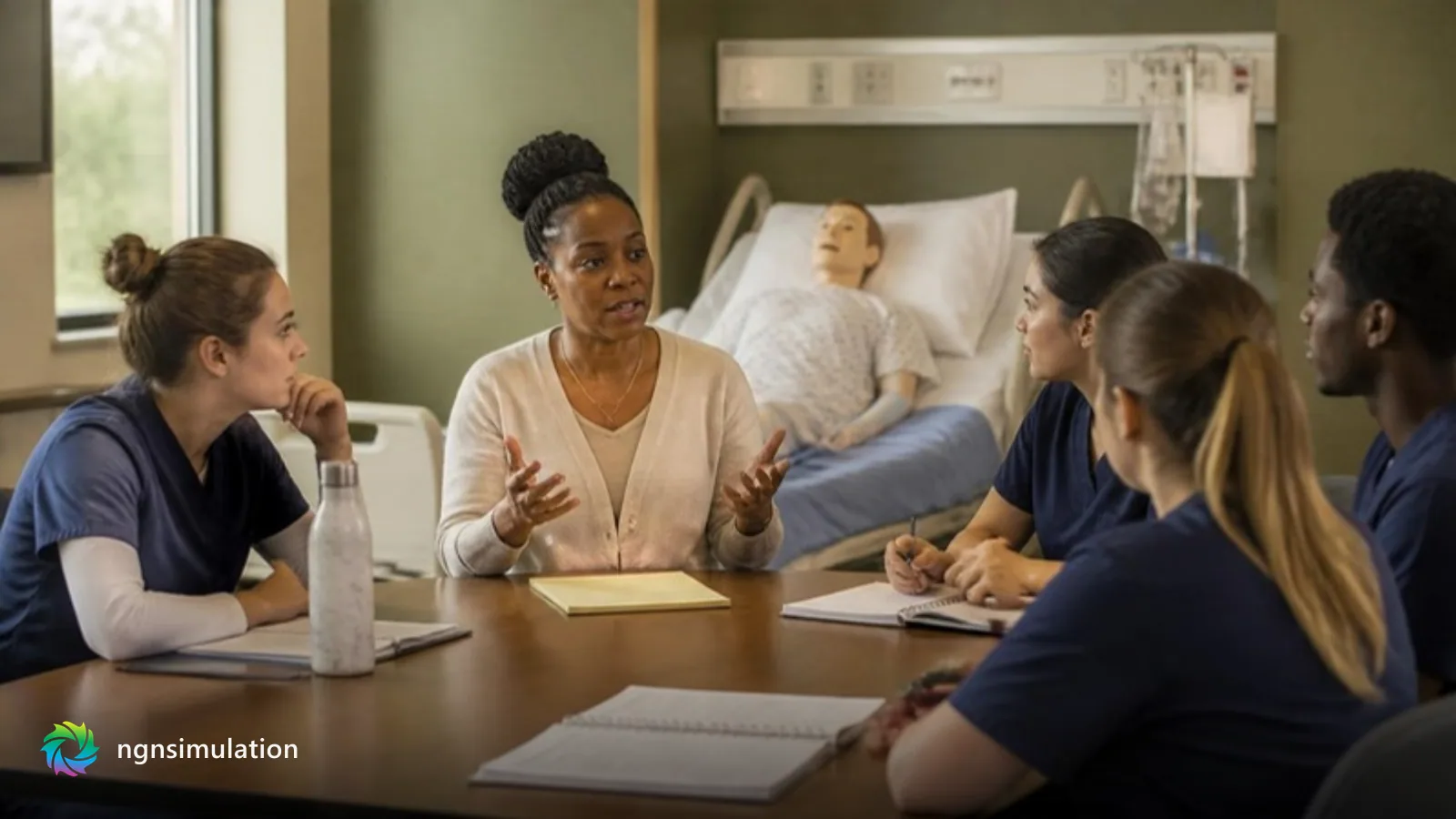
CHSE certification for simulation educators is the credential reviewers most often ask about when a program describes who runs its simulation lab. Boards and accreditors expect simulation to be led by faculty with documented training, yet many programs find that the role was handed to clinical instructors who never had a defined path into it. The Society for Simulation in Healthcare (SSH) offers three certifications in this area: the Certified Healthcare Simulation Educator (CHSE), its advanced portfolio credential (CHSE-A), and the Certified Healthcare Simulation Operations Specialist (CHSOS). This article covers what each one requires, what the CHSE costs, and how the standards behind these credentials shape faculty development.
The CHSE is designed for people who design, run, debrief, and evaluate healthcare simulation in an educational role. SSH sets two core eligibility conditions. The first is a bachelor's degree or an equivalent combination of education and experience. Candidates without a bachelor's degree may petition the Council for consideration of equivalency based on combined education and experience. The second is two years of documented continued use of simulation in healthcare education, research, or administration, with participation in healthcare simulation in an educational role. The applicant documents that use as part of the application, so a program considering the credential should start by checking whether its faculty have the simulation history on paper, not only in memory. Simulation records kept for one credential are also useful for the others, so a program that tracks hours by person and by role will be ready for any of the three applications.
The CHSE is an examination. SSH's CHSE overview page lists 115 questions with a 2-hour time limit. The application fee is USD 395 for members of SSH and supporting organizations and USD 495 for all others, and SSH states that this first application includes the first examination attempt. After approval, candidates sign up for an exam date, time, and location through SSH's Candidate Management System. The credential is valid for three years, and holders must either recertify or renew before it expires.
| Credential | Who it is for | Eligibility | Exam | Renewal | Source |
|---|---|---|---|---|---|
| CHSE | Simulation educators who design, run, and debrief scenarios | Bachelor's degree or equivalent; two years of continued simulation use in healthcare education, research, or administration; educational role | 115 questions, 2 hours; USD 395 for members or USD 495 for others, including first attempt | Valid 3 years. Renew with CPD evidence (USD 350 members, USD 450 others) or by passing the CHSE exam within the year before expiry (USD 395 members, USD 495 others) | SSH CHSE eligibility; SSH CHSE overview; SSH CHSE application; SSH CHSE renewal |
| CHSE-A | Experienced educators seeking a leadership-level credential | Current CHSE; master's degree or equivalent combination of education and experience; five years of continued simulation use in education, research, or administration; educational role | None. Portfolio-based application | Renew with CPD evidence (USD 350 members, USD 450 others) or by passing the CHSE-A exam within the year before expiry (USD 395 members, USD 495 others) | SSH CHSE-A eligibility; SSH CHSE-A overview; SSH CHSE-A renewal |
The CHSE-A is not an exam. SSH describes it as a portfolio-based certification for leaders in healthcare simulation. Applicants must already hold the CHSE and meet the CHSE-A criteria, which include a master's degree or an equivalent combination of education and experience, with a petition route for candidates who lack one, and five years of continued simulation use in healthcare education, research, or administration. SSH lists two application cycles: a submission deadline of March 1 with decisions by May 1, and a deadline of September 1 with decisions by November 1. Applicants should confirm the current degree requirement on the SSH eligibility page before applying.
The operations credential is named the Certified Healthcare Simulation Operations Specialist (CHSOS), so the abbreviation CHOS does not match SSH's title. Its eligibility is a bachelor's degree or an equivalent combination, and two years of continued simulation use in an operations specialist role. A program that relies on technicians or coordinators to run the lab, rather than faculty to teach, should look at this credential alongside the CHSE.
The NCSBN National Simulation Guidelines for Prelicensure Nursing Programs, published in 2015 in the Journal of Nursing Regulation, make faculty preparation part of the conditions for using simulation. One guideline states that lead faculty and simulation lab personnel are qualified to conduct simulation. The evidence it lists includes CVs and qualifications such as simulation conferences attended, certification in simulation instruction, training by a consultant, or targeted work with an experienced mentor. A separate guideline states that faculty are prepared to lead simulations and points to the NCSBN Simulation Faculty Preparation Checklist. The guidelines list CHSE certification among their resources.
The INACSL Healthcare Simulation Standards of Best Practice treat facilitation and debriefing as separate standards. A faculty member who runs a scenario still needs a defined method for the debrief, and the facilitation standard expects the facilitator to have the skills that simulation pedagogy requires. Certification does not replace local training, but it gives a program an external, named benchmark for who is qualified to facilitate. Reviewers who ask how a program trains its facilitators are usually asking whether that training is written down.
Simulation hours also affect clinical placement planning. Whether simulation can substitute for clinical hours depends on state and regulator rules, which are covered in does simulation count toward clinical hours. For cost planning, simulation lab cost vs virtual simulation compares lab-based and virtual models.
NGN Simulation Labs builds AI tutoring and simulation for nursing and allied health programs. Its platform offers unscripted AI patient encounters inside an EHR-style chart, including spoken OSCE practice, adaptive study with a placement check, and faculty-facing competency analytics, and it runs alongside an existing LMS. These tools support faculty development and do not replace certified faculty. Program leaders who want to see how this fits their curriculum can start at the pilot process or the demo.
Everything we write about is built into products you can try today.