
Loading…
ngnsimulation is now in active pilots with Alberta nursing & HCA programs.Request a pilot
Simulation lab cost vs virtual simulation: compare capital, staffing and cost per learner hour, and build the ROI case.
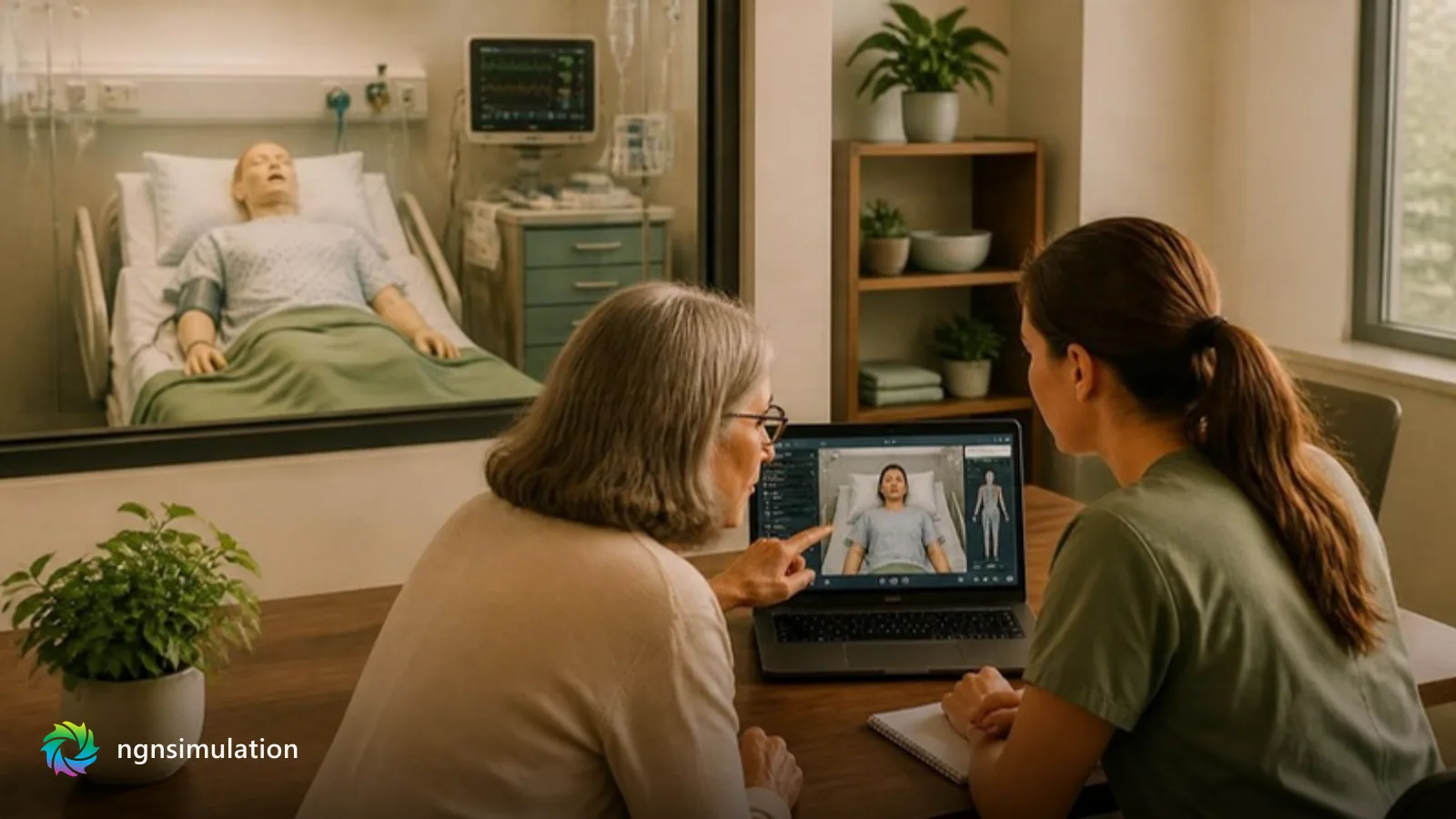
Simulation lab cost vs virtual simulation is a question of cost structure before it is a question of price. A physical high-fidelity laboratory concentrates spending in equipment, space and people, while screen-based simulation shifts spending toward licences, devices and faculty preparation.
A 2013 systematic review in Surgery by Zendejas and colleagues screened 10,903 articles and identified 967 comparative studies of simulation-based medical education. Of these, 59 studies (6.1%) reported any cost elements and 15 (1.6%) compared cost with another instructional approach. The simulator itself was the most commonly reported cost, in 42 studies (71%), and the median study reported two cost components. The authors concluded that cost reporting is infrequent and incomplete.
A later review by Hippe and colleagues in SAGE Open Medicine (2020) reached a similar position. It found 47 articles that addressed both cost and medical training and noted that estimates are not directly comparable because cost categories, assumptions, settings and time horizons differ. The authors also observed that simulation centres in high-income settings are often subsidised, which makes maintenance costs hard to estimate.
The most detailed breakdown of a single centre in the peer-reviewed record is still the Kurrek and Devitt analysis of the Canadian Simulation Centre at Sunnybrook Health Science Centre, University of Toronto (Canadian Journal of Anaesthesia, 1997). Figures are in 1996 Canadian dollars. Construction totalled $665,000, of which 85% was capital equipment and 15% was salary support. The net cost of ongoing education and research activity was $167,250 for July 1995 through June 1996, and about 65% of that was salary support absorbed by the existing departmental educational resources.
The figures are nearly three decades old and are not current prices. Their value is the shape: capital is front-loaded and visible, while operating cost is dominated by people, whose cost can sit in other budgets and vanish from a simple lab ledger. A case that counts only manikins, audiovisual systems and renovation understates annual cost.
A more recent profile comes from the Association of American Medical Colleges. Its 2023 survey of simulation programs, with 116 total responses, reported a typical profile of 10.71 paid full-time equivalents, a $1 million to $3 million operating budget, 54 rooms and 16,528 square feet. These are medical education programs, usually larger than a nursing laboratory, so they show the scale at which staffing becomes a primary line item.
Screen-based simulation changes the structure rather than removing cost. Licence fees recur annually and scale with enrolment. It avoids most space renovation, large equipment purchases and technician time, but not the faculty hours needed to brief and debrief learners. Published per-learner figures for current products are scarce, so request itemised quotations and model your own enrolment.
The Washington State research project led by Katie Haerling at the University of Washington Tacoma offers the clearest regulator-facing comparison. Prelicensure registered nursing students (152 in the sample) completed four hours of traditional clinical activity, two hours of manikin-based simulation or two hours of screen-based simulation. The project presentation ranks cost per student as manikin-based highest, screen-based in the middle and traditional clinical lowest, shown qualitatively and not as dollar values. For students in their first clinical course, two hours of high-quality manikin-based simulation performed as well as or significantly better than two hours of high-quality screen-based simulation or four hours of high-quality traditional clinical activity on cognitive learning and patient care performance measures.
The table below is a planning framework built from the cost categories used in the sources above. It contains no dollar figures.
| Cost element | Physical high-fidelity lab | Screen-based simulation |
|---|---|---|
| Capital | Manikins, audiovisual and debrief systems, renovation | Devices and network capacity |
| Space | Dedicated rooms, storage and debrief areas | Any room or home with a device |
| People | Operations staff and technicians, often the largest recurring cost | Light support and licence administration |
| Faculty time | Scenario design, facilitation and debriefing | Scenario selection, briefing and debriefing |
| Maintenance and consumables | Service contracts, supplies and repairs | Annual licence renewal |
| Scaling with enrolment | Limited by room hours and staff | Limited by licence count and faculty review time |
Return on investment in simulation is easiest to defend when it is expressed per learner hour, because that unit applies to both modalities. Start with the full annual cost of each option: capital depreciation, operating staff including salary support held in other budgets, maintenance, consumables, licences and faculty hours. Divide by the learner hours actually delivered, not the hours the room or licence could deliver.
A simple hypothetical shows why utilisation matters. If a lab cost 200,000 dollars a year in total and delivered 4,000 learner hours, the cost per learner hour would be 50 dollars. If the same lab delivered 8,000 learner hours, it would be 25 dollars. The figures are invented for illustration.
Where rules allow simulation to replace some clinical hours, the savings case strengthens, but only if the conditions behind the evidence are met. The NCSBN National Simulation Study (Hayden, Smiley, Alexander, Kardong-Edgren and Jeffries, 2014) was a longitudinal randomised controlled study in ten prelicensure programs, five baccalaureate and five associate degree. NCSBN summarises the result in its Simulation Guidelines: with up to 50% simulation there were no statistically significant differences from the control group, which used 10% or less simulation, or from a 25% group, in knowledge acquisition and clinical performance.
The same guidelines state the conditions. Simulation may be integrated across the prelicensure curriculum provided that faculty are adequately trained, committed and in sufficient numbers, there is a dedicated simulation lab with appropriate resources, the vignettes are realistically and appropriately designed, and debriefing is based on a theoretical model. These conditions are themselves cost lines: faculty preparation and debriefing time belong in the model. Substitution also does not create clinical placement seats. It can replace some hours where regulators allow, but the allowable proportion is set by each regulator, so confirm your own rules first.
NGN Simulation Labs, an Alberta-based company, offers unscripted AI patient encounters inside an EHR-style chart, including spoken OSCE practice, adaptive study and quizzing with a placement check, and faculty-facing competency analytics, and it runs alongside an existing LMS. Programs weighing a physical lab against screen-based options can test their own assumptions in the calculator at the ROI estimator, and can see a hands-on trial through the pilot process.
Everything we write about is built into products you can try today.