
Loading…
ngnsimulation is now in active pilots with Alberta nursing & HCA programs.Request a pilot
What CoARC, CoAEMSP, JRC-DMS, ARC/STSA, ASHP, CODA and NAACLS say about simulation counting toward clinical or hands-on hours.
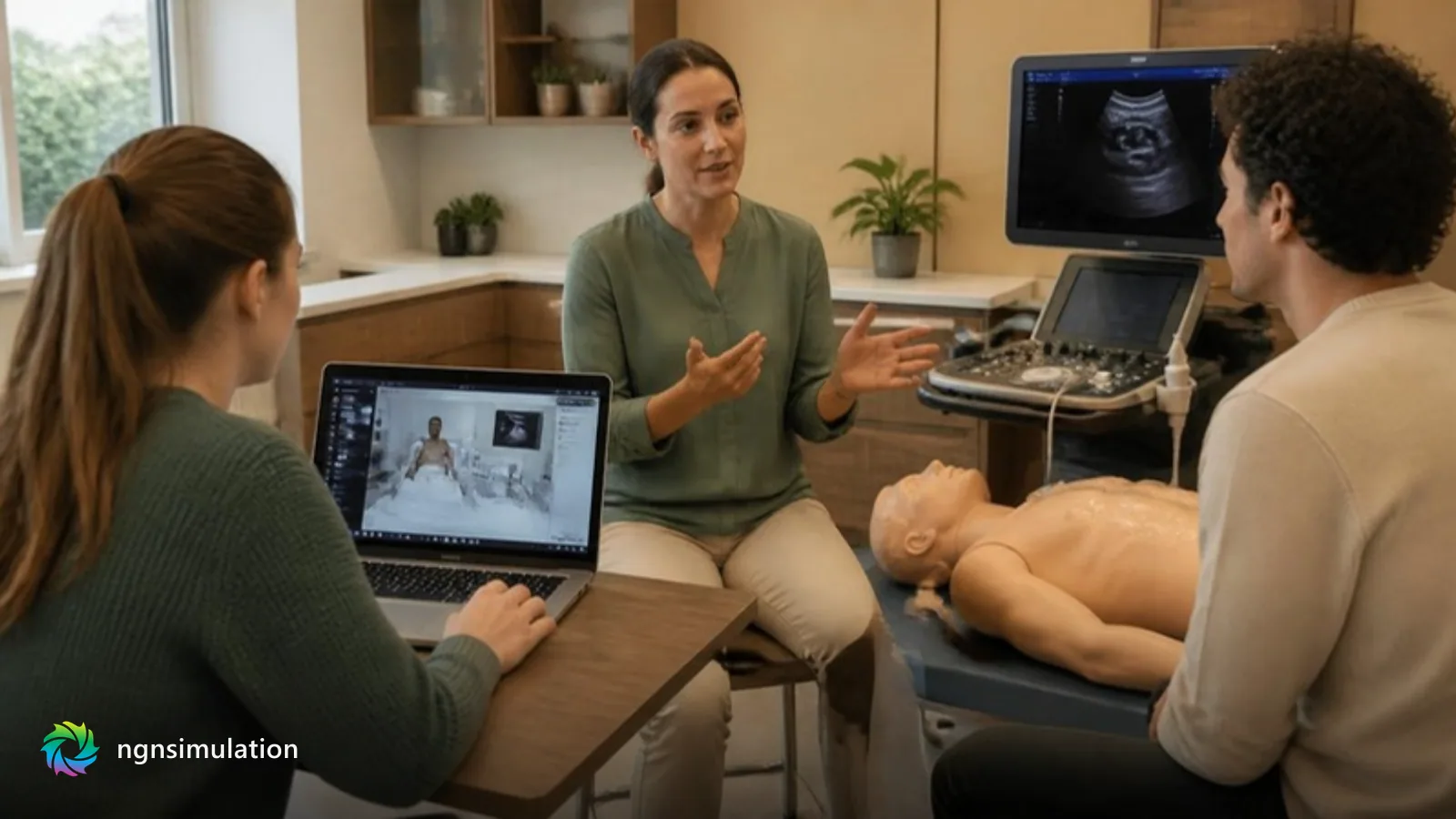
Do virtual simulations count as hands-on hours? In allied health education the answer depends on the accreditor, and it ranges from a written cap with a conversion rate to an explicit prohibition. Programs comparing hands-on kits with online labs are often asking a narrower question than the standards answer: whether the hours can be credited toward required clinical or practical experience. This article reports only what seven accrediting bodies' published documents say, including where they are silent.
The phrase hands-on covers three separate categories in accreditation documents. Laboratory or preclinical instruction is supervised campus practice on models, manikins or other simulation methods. Clinical education is patient care in real facilities under supervision. Simulation is a technique that can sit in either category depending on the accreditor.
A simulation hour that strengthens a skill before a placement is an instructional decision. A simulation hour counted in place of a placement hour is a substitution, and substitution is what accreditors regulate.
The table summarizes the published language reviewed, as in force in October 2026 plus one standard effective January 1, 2027. Programs should read the current document for their own discipline.
| Discipline | Accreditor | What the standards say about simulation counting | Source |
|---|---|---|---|
| Respiratory therapy | CoARC | 2027 standards (effective January 1, 2027): a maximum of 25% of required clinical clock hours and associated clinical competency evaluation may be completed through simulation; one simulation hour may count as two clinical hours | CoARC 2027 Entry Standards |
| Paramedic and EMS | CAAHEP with CoAEMSP | Simulation supplements clinical experience and does not replace all of it; no recommended number of simulations per live encounter; the program decides any ratio | CoAEMSP and NREMT simulation guidelines, revised 2026 |
| Diagnostic medical sonography | CAAHEP with JRC-DMS | Some scan proficiencies may be shown in a simulated environment, but clinical competency must be assessed in a clinical affiliate; simulation is not an option for clinical competency requirements at this time | CAAHEP DMS standards; JRC-DMS interpretive guide |
| Surgical technology | ARC/STSA | Simulation cannot be substituted for clinical experience; counted cases must be live surgical procedures | ARC/STSA clinical evaluation and expectations policy, 2026 |
| Pharmacy technician | ASHP and ACPE | Simulation is a required 50-hour modality, separate from the 120-hour experiential modality, and prepares students for it | ASHP/ACPE pharmacy technician standard, 2026 |
| Dental hygiene | CODA | Preclinical instruction may use manikins or other simulation; clinical education means patient care; no provision found crediting simulation as clinical education | CODA dental hygiene standards |
| Medical laboratory science and technology (US) | NAACLS | Requires clinical or applied learning with an assigned preceptor; the text reviewed contains no provision on simulation | NAACLS standards for accredited programs |
The CoARC 2027 entry standards were approved on March 21, 2026 and take effect on January 1, 2027. They are specific. Up to 25% of the program-required clinical clock hours, with the associated clinical competency evaluation, may be completed through simulation, and one simulation hour may be counted as two clinical hours.
As an illustration (ours, not CoARC's), a program requiring 400 clinical hours could credit at most 100 of them to simulation, which would take 50 simulation hours at the two-to-one rate.
Simulation must include pre-briefing, the structured activity, theory-based debriefing and evaluation. Hours used as clinical substitution may not also be counted as laboratory hours, and the student-to-instructor ratio cannot exceed 6:1. A virtual simulation without facilitation and debriefing would not meet this description.
The joint CoAEMSP and NREMT guidance, revised in 2026, describes simulation as appropriate for learning and competency evaluation, and says entry-level competency is determined using simulation, clinical and field assessments. It also says simulation is not a replacement for all live patient experiences, and that there is no recommendation for how many simulations can replace a live encounter.
The document states that it does not define requirements. It leaves any ratio to the program and says simulation used in lieu of a live encounter should be high fidelity, a term it applies to any mode, including virtual reality, manikins and task trainers. The binding minimums are in the CAAHEP standards, which this article did not review.
The JRC-DMS standards allow some scan proficiencies, such as abdominal vascular Doppler assessment, to be demonstrated in a clinical setting or a simulated environment. The same standards say clinical competency must be assessed in a diagnostic clinical affiliate. The interpretive guide is direct: simulation of sonographic examination competence, at this time, is not an option for programs to fulfill clinical competency requirements.
ARC/STSA is equally direct for surgical technology: simulation cannot be substituted for clinical experience, and cases counted toward the core curriculum must be completed during live surgical procedures.
The 2026 ASHP and ACPE pharmacy technician standard requires at least 400 hours across three modalities, with 50 hours of hands-on simulation and 120 hours of experiential training. Simulation here is a required stage that prepares students for externship, not a credit against it.
The CODA dental hygiene standards define laboratory or preclinical instruction as supervised experience using study models, manikins or other simulation methods, and clinical education as the patient care experiences required for competence. The text reviewed does not credit simulation as clinical education. NAACLS requires clinical or applied learning with an assigned preceptor, and the text reviewed says nothing about simulation. Silence is not permission, so a program should ask before relying on simulation for clinical credit.
ngnsimulation offers unscripted AI patient encounters inside an EHR-style chart, including spoken OSCE practice, adaptive study and quizzing with a placement check, and faculty-facing competency analytics, running alongside an existing LMS. Whether simulated hours may be credited is a decision for each program and its accreditor. For nursing rules, see does simulation count toward clinical hours, and for requirements by role, see the free licensure map at the licensure map.
Everything we write about is built into products you can try today.