
Loading…
ngnsimulation is now in active pilots with Alberta nursing & HCA programs.Request a pilot
CRT vs RRT respiratory therapy credentials compared: how each is earned before and after 2027, state licensure rules, eligibility and maintenance.
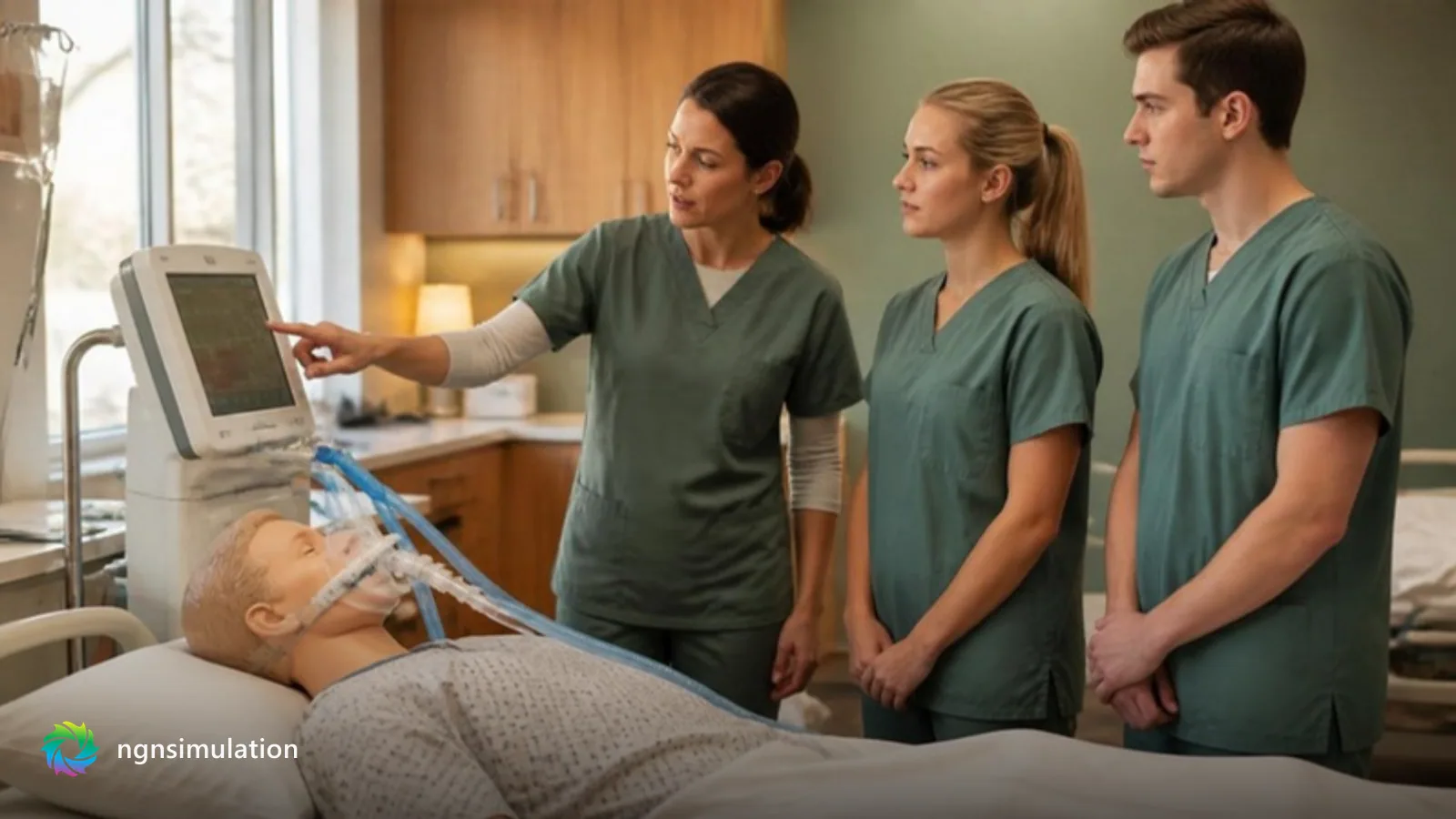
CRT vs RRT: respiratory therapy credentials are two designations issued by the National Board for Respiratory Care (NBRC), and the way each is earned changes on January 1, 2027. The Certified Respiratory Therapist (CRT) is the entry credential. The Registered Respiratory Therapist (RRT) is the higher credential, which the NBRC describes as holding a standard that has applied since 1961.
Through 2026 the two credentials are earned through different combinations of exams. From 2027, one examination with two cut scores decides both. The details below come from NBRC and American Association for Respiratory Care (AARC) pages.
The CRT is earned by passing the TMC at the low cut score. Applicants must be 18 or older and hold at least an associate degree from a CoARC-supported or accredited entry-into-practice respiratory therapy program. Foreign respiratory therapy education does not qualify for admission to the TMC.
The RRT is the advanced credential. Under the current system it is earned in two steps: the candidate reaches the TMC high cut score and then passes the CSE, a simulation examination of 22 problems (20 scored and 2 pretest) taken over four hours. The NBRC states that passing the TMC at the high cut score does not by itself confer CSE eligibility, because every candidate must meet the CSE eligibility requirements regardless of score.
The TMC has 160 items (140 scored and 20 pretest) and is taken over three hours. It has two cut scores. Reaching the low cut score earns the CRT. Reaching the high cut score also earns the CRT and, for candidates who qualify, opens the door to the CSE. The NBRC does not publish the numeric cut scores on its credential pages.
RRT eligibility for the TMC also allows several routes beyond graduation from an associate-level program: the CRT held for four or more years with 62 semester hours of college credit, or for two or more years with an associate degree from an accredited entry-level program. These CRT-to-Registry pathways are scheduled to end.
The NBRC Board of Trustees voted at its April 9, 2022 meeting to adopt a single examination, named the Respiratory Therapy Examination, and implementation is set for January 2027. It contains 185 multiple-choice items (160 scored and 25 pretest) with a four-hour time limit. One section assesses breadth of knowledge and another assesses depth of clinical judgment, organized by patient type, setting, patient age and clinical activity.
The exam has two cut scores. Candidates who reach the low cut score earn the CRT, and those who reach the high cut score earn the RRT. The CSE is being eliminated. The NBRC also announced that the CRT-to-Registry admission policies end effective December 31, 2026. A candidate who has not earned the RRT by January 1, 2027 must hold a CoARC-accredited associate degree to qualify for the new examination. Fees listed by the NBRC are $360 for new applicants and $300 for repeat applicants.
A transition provision protects candidates already partway through. Someone who passed the TMC at the high cut score before December 31, 2026 and has not completed the CSE may take the CSE through December 31, 2027, or instead take the new examination after January 1, 2027 and pass at the high cut score to earn the RRT. Program-level implications are discussed in nbrc 2027 exam change rt programs.
| Feature | CRT | RRT |
|---|---|---|
| Role in the credential ladder | Entry credential | Advanced credential, standard held since 1961 |
| Earned through 2026 | TMC at the low cut score | TMC at the high cut score, then the CSE |
| Earned from January 2027 | Respiratory Therapy Examination, low cut score | Respiratory Therapy Examination, high cut score |
| Minimum education for new applicants | Associate degree from a CoARC-supported or accredited entry-into-practice program | Same degree baseline from 2027 for anyone without an RRT by January 1, 2027 |
| Clinical Simulation Examination | Not required | Required through the transition, available through December 31, 2027 for eligible candidates |
The NBRC states that all 49 states that regulate respiratory care use the CRT or the RRT credential as the basis for state licensure. The credential is therefore a qualification for a license and not a license itself. The NBRC is explicit that recertifying an NBRC credential does not renew a state license, and that the NBRC and state boards do not share information, so a therapist must update each separately.
The AARC maintains a list of states that require the RRT as entry to licensure. Its table shows Ohio and California (January 1, 2015), Arizona (January 1, 2017), Oregon and New Mexico (January 1, 2018), Georgia (March 15, 2020), Washington and West Virginia (July 1, 2022), Missouri (January 1, 2027) and Indiana (January 1, 2028). New Jersey's 2017 law is listed as rescinded.
Grandfathering varies. Missouri accepts an active CRT earned before January 1, 2027, and Georgia accepts an active CRT issued before March 15, 2020. Arizona does not license an out-of-state therapist who holds only the CRT. Graduates should check the board where they intend to practise, and the licensure map offers a free starting reference.
The pages reviewed do not publish a comparison of scope of practice or employer preference between the CRT and the RRT. Scope is set by each state's practice act, so this article claims no general pay or hiring advantage. The one sourced consequence is regulatory: where a state requires the RRT for entry, a CRT alone does not qualify a new applicant.
The NBRC states that credentials issued beginning July 1, 2002 are valid for five years, and that the Credential Maintenance Program (CMP) applies to every credential held. There are three routes: complete quarterly assessments and, depending on results, submit continuing education; retake and pass the examination for the highest credential held during the last year of the period; or pass a different NBRC examination. The last two require no continuing education submission.
Canadian respiratory therapists do not use NBRC credentials for entry to practice. Testing there is handled by Health Professionals Testing Canada, formerly the Canadian Board for Respiratory Care. The Canadian pathway is described in how to become a respiratory therapist in canada.
ngnsimulation provides unscripted AI patient encounters inside an EHR-style chart, including spoken OSCE practice, plus adaptive study and quizzing with a placement check and faculty-facing competency analytics, alongside an existing LMS. See the ROI estimator, the pilot process and the demo.
Everything we write about is built into products you can try today.