
Loading…
ngnsimulation is now in active pilots with Alberta nursing & HCA programs.Request a pilot
CSMLS vs ASCP lab technologist exams compared: eligibility, format, scoring, fees and how Canadian and US regulation differ for MLT and MLS candidates.
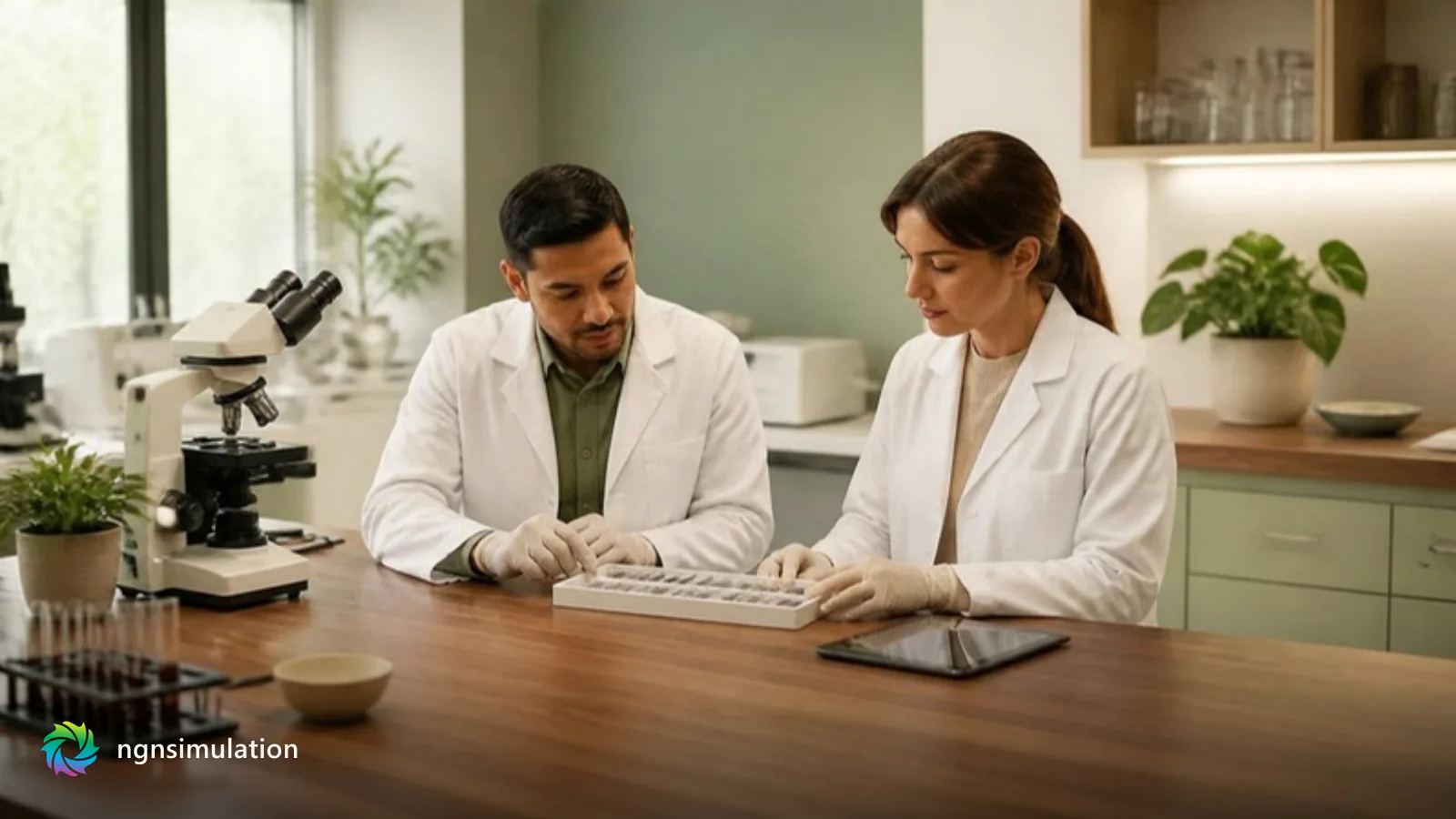
CSMLS vs ASCP lab technologist exams is a comparison between two certification bodies that play different roles. The Canadian Society for Medical Laboratory Science (CSMLS) runs the national certification exam that feeds provincial regulation in Canada, while the American Society for Clinical Pathology Board of Certification (ASCP BOC) runs a credential that is voluntary in most US states and a licensure prerequisite in some. This article sets the two side by side.
In Canada, the CSMLS certification exam is the entry-to-practice exam for medical laboratory technologists where the regulator relies on it. The College of Medical Laboratory Technologists of Alberta (CMLTA) states that new graduates of approved Canadian programs in Alberta must be registered to write the CSMLS exam before registering with the College. CMLTA also describes a labour mobility agreement between MLT regulatory colleges across Canada.
In the United States, the ASCP credential is usually described as certification rather than licensure. The American Society for Clinical Laboratory Science (ASCLS) notes that being uncertified may make it harder to find a job but is not unlawful, while practising without a required state license is. Most states that do license laboratory personnel, with California the exception, require documentation of certification from an acceptable agency.
CSMLS lists two ways to become initially eligible for the General MLT exam: graduation from an EQual accredited Alberta medical laboratory educational program, or the CSMLS Prior Learning Assessment route, and in both cases the candidate must reside in Alberta. The CMLTA reports that December 31, 2026 is the final date to submit a new General MLT Prior Learning Assessment application to CSMLS, and that it is developing an Alberta-based process expected from January 1, 2027. Internationally educated technologists enter through the CSMLS assessment process before they can register for an exam.
ASCP publishes separate routes for each credential, and a candidate must satisfy at least one. The MLS credential has Routes 1, 2, 4, 5 and 6, with Route 3 discontinued. Route 1 combines a baccalaureate with a NAACLS program, Routes 2, 4 and 5 add clinical experience (Routes 2 and 5 also certification), and Route 6 uses a US military laboratory training course. The MLT credential has Routes 1, 3 and 4, with Route 2 discontinued, built on an associate degree with an accredited program, US military training, or clinical experience. ASCP states that education does not need to be from the United States.
The CSMLS General MLT exam is made up of multiple-choice questions, some with images, and no case studies. Each correct answer earns one mark, and up to 20 percent of questions may be new items validated before being scored. The pass mark is set by the Angoff method and varies with the difficulty of the form.
ASCP questions are also multiple choice, with four options and one best answer. Candidates must answer each question before moving on, although they can flag items for review. ASCP describes criterion-referenced computerized adaptive testing, where the system selects questions using the content guideline and the candidate's estimated ability. Exams are delivered at Pearson testing centers, and a preliminary pass or fail appears on screen. ASCP also lists an 80-question, 2-hour MLT exam, but that version is for California state licensure only.
| Feature | CSMLS General MLT | ASCP MLS and MLT |
|---|---|---|
| Questions | 210 multiple choice | 100 multiple choice |
| Time | 3.5 hours | 2 hours and 30 minutes |
| Format | Fixed form, no case studies | Computerized adaptive test |
| Scoring | Pass mark set by Angoff method, varies by exam | Scaled 100 to 999, minimum pass 400 |
| Eligibility | Alberta program or Prior Learning Assessment, and Alberta residence | Six MLS routes, four MLT routes, one discontinued in each |
| Sessions | Three sessions listed for 2027 (February, June, October) | Scheduled at Pearson testing centers |
| Fee listed | 2027: $999 member, $1,285 non-member (Canadian funds, Canadian resident) | Application fee: $260 MLS, $235 MLT |
| Governing context | Provincial regulators such as CMLTA | Voluntary, or accepted by licensing states |
CSMLS posts exam weeks for each year. For 2027 it lists sessions from February 22 to 26, June 21 to 26 and October 25 to 29, and each candidate schedules a seat for one exam day only. Under the attempt policy effective with the October 2026 session, General MLT candidates have four attempts, with the three further attempts due within three years of the first or by October 27, 2028, whichever comes first.
Canada regulates through provincial colleges, and the CSMLS exam serves as the shared entry standard. The picture is shifting. CMLTA states that after March 1, 2026, a graduate who does not register in Alberta and then moves elsewhere will not qualify for labour mobility, and would instead complete assessments from the Canadian Alliance of Medical Laboratory Professionals Regulators (CAMLPR) in five disciplines: clinical chemistry, hematology, transfusion medicine, clinical microbiology and histology. Anyone planning a move across provinces should read their destination college's current requirements.
In the United States, ASCLS reports 10 states with laboratory personnel licensure: California, Hawaii, Florida, New York, North Dakota, Tennessee, Louisiana, Nevada, West Virginia and Montana, plus Puerto Rico. Requirements vary, but they usually include fees, continuing education and minimum education and competency standards. Most of these states, except California, require documentation of certification from an acceptable agency. California requires a state examination, and ASCLS states that certification does not equal licensure there. Licensing states should be contacted early in the planning process.
None of the CSMLS, CMLTA or ASCP pages reviewed describe direct reciprocity between the Canadian and US credentials. ASCP accepts education from outside the United States, and CSMLS has an assessment process for internationally educated technologists. In each direction the receiving regulator or licensing board makes the final decision, so a candidate should ask the destination body in writing which credential it accepts.
ngnsimulation builds unscripted AI patient encounters inside an EHR-style chart, adaptive study and quizzing with a placement check, and faculty-facing competency analytics, and it runs alongside an existing LMS. The free licensure map at the licensure map covers 57 roles across 64 jurisdictions, and the related guide at medical laboratory technologist certification canada csmls covers the Canadian pathway in more detail.
Everything we write about is built into products you can try today.